
Focus Keyword: How to Teach Kids About Money
Are you struggling to explain the value of a dollar to your children? You aren’t alone. Many parents find it difficult to start the conversation, but learning How to Teach Kids About Money is one of the most vital life skills you can provide. In a world of digital payments and “one-click” buying, money can feel invisible to a child.
If you want your children to avoid debt and build a secure life, you must make financial literacy a hands-on experience. Here are 7 powerful strategies to turn your kids into money masters.
1. Start with the “Clear Jar” Method
The first step in How to Teach Kids About Money is making it visual. Piggy banks are classic, but they hide the progress. Instead, use a clear glass jar.
When children see the pile of coins and bills growing physically, it creates a psychological “win.” They start to understand that saving isn’t just about hiding money away—it’s about growth. Talk to them about the sound the coins make and let them count the total once a week.

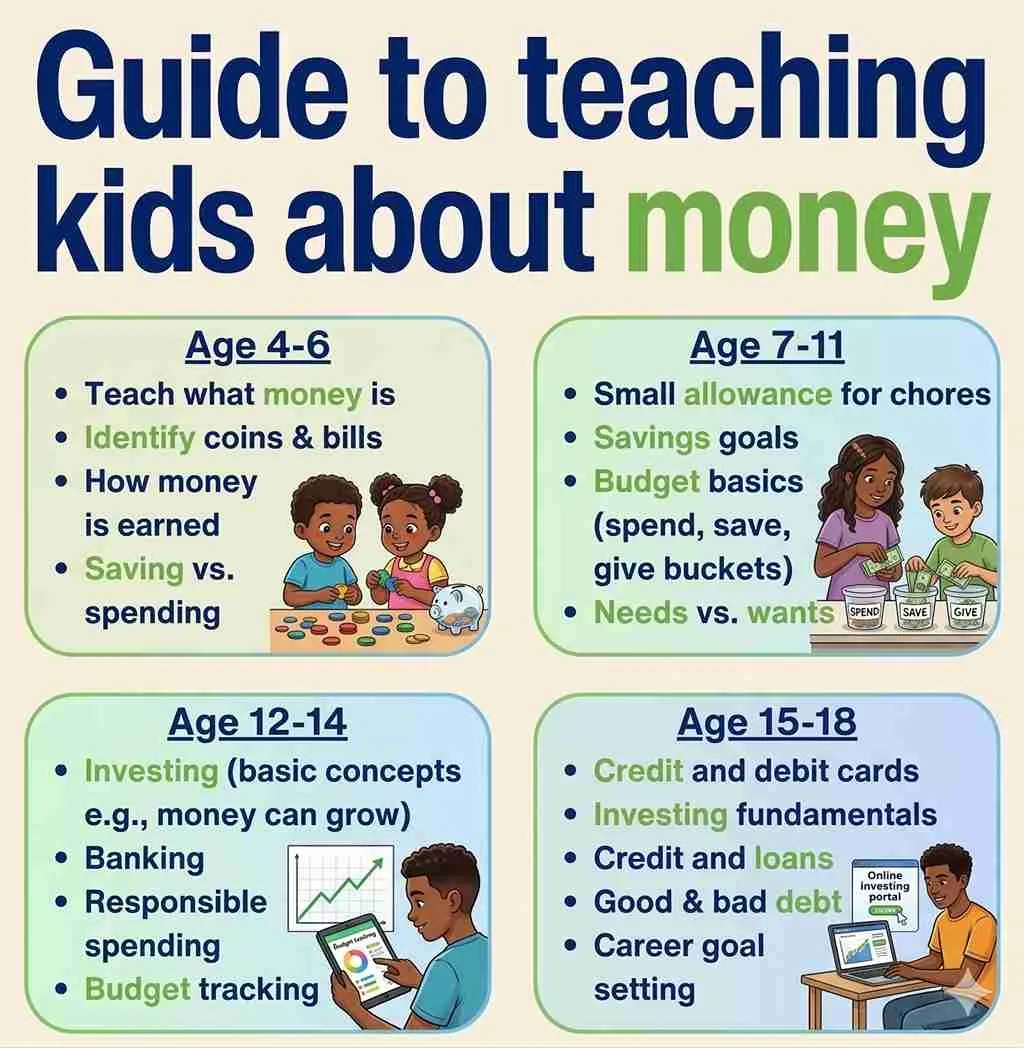
2. Introduce the Three-Category System: Save, Spend, Give
Money isn’t just for buying toys. To truly understand How to Teach Kids About Money, children need to learn about balance. Create three separate containers:
Spending: For small immediate treats (candy, stickers).
Saving: For “Big Goal” items (a Lego set or a video game).
Giving: To teach empathy by donating to a local charity or a friend in need.
This system teaches them that every dollar has a mission. It prevents the habit of “impulse buying” that ruins many adult finances.
3. Explain the Difference Between Wants and Needs
This is a cornerstone of financial literacy. During your next grocery trip, play a game. Ask your child, “Is milk a want or a need?” or “Is that new toy a want or a need?”
When you Teach Kids About Money, you are teaching them priority. Explain that “Needs” (housing, basic food, electricity) must be paid first before “Wants” (entertainment, luxury snacks) can be considered.
4. Let Them Make “Small” Mistakes Now
It is better for a 7-year-old to waste $5 on a broken toy than for a 27-year-old to waste $5,000 on a bad car loan. If your child insists on buying a low-quality trinket, let them.
When it breaks two hours later, don’t rush to replace it. Use it as a teaching moment. Discuss how they could have saved that money for something higher quality. Experience is often the best teacher when learning How to Teach Kids About Money.
5. Show Them That Stuff Costs Money
In the age of Apple Pay and Credit Cards, kids think money is an infinite digital resource. To fix this, use cash occasionally. Let them physically hand the bills to the cashier.
When they see the money leave their hand and realize they don’t get it back, the concept of “scarcity” becomes real. This is a fundamental lesson in How to Teach Kids About Money that digital apps simply cannot replicate.
6. Use “Opportunity Cost” Language
Instead of just saying “No, we can’t afford that,” change the narrative. Say, “If you buy this video game today, you won’t have enough money for the bike you wanted next month.”
This teaches kids that every financial choice is a trade-off. It empowers them to make decisions rather than feeling restricted by a “No.”
7. Lead by Example
You are your child’s primary financial role model. If you are constantly complaining about bills or making impulsive luxury purchases, they will mimic that behavior.
Be transparent (in an age-appropriate way) about how you save for family vacations or why you chose a specific insurance plan. When you model healthy habits, How to Teach Kids About Money becomes a natural part of your daily life.
Summary
Teaching children about finance isn’t a one-time lecture; it is a series of small, daily habits. By starting early with visual tools and real-world consequences, you set them up for a lifetime of success.